
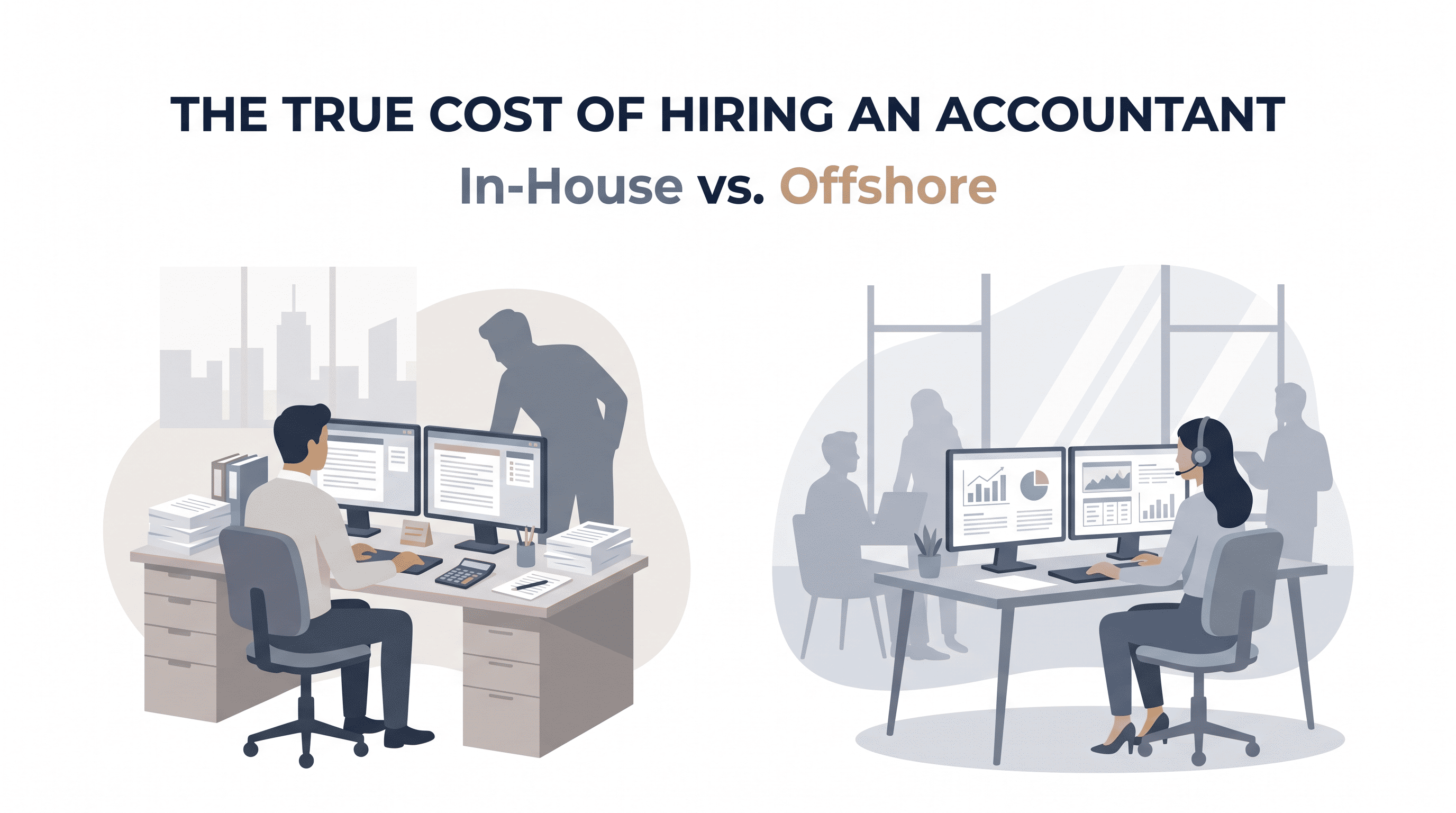
If you run a CPA firm or manage a finance team, you already know the feeling. Work keeps coming in, good people are hard to find, and every new hire adds pressure to your margins—leading many practices to evaluate options like outsource tax preparation services. When a partner asks about the cost of hiring an accountant, the first number that comes to mind is usually the salary. That number is only the start.
The real price of a full-time employee includes taxes, benefits, software, equipment, training, recruiting, and the cost of replacing that person when they leave. Add those up and the bill is often 40 to 50 percent higher than the salary on the offer letter.
This post walks through the true cost of a full-time accountant in the United States, compares it with the cost of an offshore accountant, and shows how much CPA firms can save when they use a mixed team. The numbers below are estimates based on typical US market ranges. Your own costs will vary by city, firm size, and benefits plan, so use the math as a template and plug in your own figures.
How Much Does It Cost to Hire an Accountant?
Let's start with base pay, since that is where most budgets begin. Salaries differ a lot by market. A firm in New York or San Francisco pays more than a firm in Ohio or Texas. As a rough guide for 2026, standard US annual salary ranges run as follows: an entry-level staff accountant earns between $55,000 and $70,000; an experienced staff accountant makes $70,000 to $90,000; a senior accountant commands $85,000 to $110,000; and a CPA manager earns between $110,000 and $150,000.
The accountant salary is the biggest line item, but it is not the whole cost. When someone asks how much it costs to hire an accountant, the honest answer is the salary plus everything that comes with an employee.
The Fully Loaded Cost of a Full-Time Accountant
Fully loaded cost means the total amount a firm spends to employ one person for a year. To keep this simple, consider a staff accountant earning a $75,000 base salary.
On top of the $75,000 base pay, payroll taxes for Social Security, Medicare, and unemployment run about $7,250. The employer’s share of healthcare benefits typically costs $8,000, and a standard 3 percent retirement match adds $2,250. Software licenses average $4,500, while equipment and physical office space add $6,000. Annual training and CPE take another $2,000. Adding third-party recruitment fees averaged over three years ($5,000) and an ongoing turnover allowance ($5,000) brings the total fully loaded cost to $110,000 per year.
That total is about 47 percent above the base salary. The employee takes home $75,000 before tax, but the firm pays $110,000 to keep that seat filled.
Now look at the hours. A full-time employee works about 2,080 hours a year on paper. After vacation, holidays, and sick days, that drops to about 1,840 productive hours. Divide $110,000 by 1,840, and the true hourly rate is close to $60. That is a very different number from the $36 an hour you get by dividing salary alone.
Employee Benefits and Payroll Taxes
Employers pay Social Security and Medicare taxes on every paycheck, plus federal and state unemployment taxes and workers' compensation insurance. Most firms also offer health insurance, paid time off, and a retirement match to stay competitive. These employee benefits quietly add 15 to 25 percent on top of salary.
Software Licenses and Equipment
Every accountant needs a computer, monitors, security tools, and licenses for tax, audit, and practice management software. Programs like CCH Axcess, UltraTax, CaseWare, and QuickBooks all charge per user. Add office space, furniture, and internet costs, and you can spend $10,000 or more per seat each year.
Training and CPE
New hires need time to learn your systems and your standards. During that period, they work slower and need help from senior staff. Continuing education adds another direct cost each year.
Hiring Cost and Recruitment Fees
Hiring cost is easy to overlook because it happens once, but it is real. Staffing agencies often charge 15 to 25 percent of the first-year salary. For a $75,000 hire, that means $11,250 to $18,750 upfront. Even if you recruit on your own, you pay for job postings, screening, interviews, and the billable time your partners and managers spend on the process.
Then comes the ramp-up. A new accountant may take three to six months to reach full speed. Your managers spend extra time reviewing work and answering questions, and that time is not free.
Staff Turnover and Its Hidden Cost
Staff turnover is one of the most expensive problems in public accounting. Busy seasons burn people out, and many accountants leave after one or two years. Industry estimates for the cost of replacing an employee range from half of the annual salary to more than double it, once you count recruiting, training, lost productivity, and the strain on the rest of the team.
Even using the low end, replacing a $75,000 accountant costs about $37,500. If your firm loses one person out of every four each year, that cost adds up quickly. It also hurts client relationships, because clients dislike working with a new face every season.
Cost of Hiring a CPA in 2026
The cost of hiring a CPA in 2026 is higher than it was a few years ago. Demand for licensed professionals remains strong, and many firms are competing for the same small pool of candidates. Salary expectations have gone up, remote work has given candidates more choices, and signing bonuses are now common at larger firms.
For a CPA manager earning $125,000, the same loading math gives a fully loaded cost near $175,000 to $190,000 a year. Many firms need several of these roles, and the total expense grows fast.
The CPA Shortage and What It Means for Your Budget
The CPA shortage is not a rumor. Fewer students are choosing accounting as a major, fewer graduates are sitting for the CPA exam, and a large share of working CPAs are approaching retirement. At the same time, the workload keeps growing with more regulations, more clients, and more complex returns.
This gap pushes salaries up and makes hiring slower. A role that used to fill in a month can now stay open for three or four. Every open seat means missed deadlines, overtime for the current team, or turned-away clients. For many firms, the shortage is the main reason to look at other staffing models.
What Does an Offshore Accountant Cost?
An offshore accountant is a trained professional who works for a provider in a country like India and supports your firm remotely. Many of these professionals hold degrees in accounting, and some hold credentials such as CA, CMA, or EA. They work in your systems, follow your checklists, and report to your managers.
Pricing models vary. Most providers offer a dedicated full-time team member for a fixed monthly fee, while others bill by the hour or by the project. For a dedicated staff accountant, a typical range is $3,000 to $4,500 per month, or $36,000 to $54,000 per year. That fee usually covers salary, benefits, workspace, equipment, software at the provider's end, training, management, and the provider's own overhead. You do not pay payroll taxes, recruiting fees, or turnover costs separately.
Of course, you should add some cost on your side. Your local managers will spend time on instructions and review, and you may need secure remote access tools. A fair estimate is another $4,000 to $8,000 per year per offshore team member for oversight and tools.
Offshore vs. Onshore Accounting Cost Comparison
Looking at the numbers side by side reveals the financial contrast between the two models:
A US in-house hire requires a base salary of around $75,000, plus payroll taxes and benefits totaling $17,500, software, equipment, and office costs of $10,500, and recruitment and turnover costs of about $10,000, for an annual total of $110,000.
By contrast, an offshore accountant entails a flat service fee of around $45,000. In this model, the service provider handles and includes payroll taxes, benefits, equipment, office overhead, recruitment, and turnover. Factoring in roughly $6,000 for your firm's local oversight and connection tools, the estimated annual total comes to $51,000.
In this scenario, the offshore option costs about $59,000 less per year—a direct savings of roughly 54 percent. Many firms report savings between 40 and 60 percent once they account for review time. You are not paying less for lower-quality work; you are paying less because you are not carrying the heavy overhead of a local employee.
In-House vs. Outsourced Accounting Cost for the Whole Team
One hire is a small example, but most firms need a team. If your firm needs five staff accountants to handle ongoing growth:
Five US hires at about $110,000 each total roughly $550,000 per year. Five offshore team members at about $51,000 each cost around $255,000 annually. That creates a difference of approximately $295,000 every single year.
For a mid-sized firm, that amount can fund a new partner, a major marketing push, better technology, or higher profit margins. This is where CPA firm overhead reduction becomes a tangible strategy rather than just a talking point.
How Much Can CPA Firms Save by Outsourcing?
The size of the savings depends on how you use the team. Several practical patterns stand out:
- Tax preparation: Firms send 1040, 1120-S, and 1065 preparation offshore while keeping final review and client advisory local. This routinely cuts cost per return by 40 percent or more.
- Bookkeeping and write-up work: Daily transaction processing and reconciliations are well suited to offshore teams, frequently delivering savings above 50 percent.
- Audit support: Testing and workpaper preparation can move overnight, enabling managers to review finished work every morning.
- Payroll and accounts payable: These repeatable, rule-based tasks are straightforward to hand off cleanly.
To estimate your own savings, take the hours you spend on routine work each week, multiply by your true fully loaded hourly cost, and compare that with the offshore rate. Be sure to subtract the estimated review time your managers will need.
Virtual Accounting ROI
Virtual accounting ROI measures what you gain compared with what you spend. You can calculate it in four simple steps:
- Add up the yearly cost of the work you plan to outsource, including all local employee overhead.
- Add up the yearly cost of the offshore team plus your internal oversight and tooling costs.
- Subtract the second number from the first to isolate your annual net savings.
- Divide the net savings by the total cost of the offshore team to determine your return.
Using the staff accountant example, the annual savings is $59,000 against an offshore operational cost of $51,000. That produces a return of about 116 percent in the first year with no massive upfront capital investment. Most firms also gain non-monetary benefits, including fewer missed filing deadlines, reduced team burnout, and more partner availability for high-fee advisory services.
Total Cost of Ownership and Scalability
A smart decision evaluates the total cost of ownership rather than just the monthly invoice. That includes accounting for potential rework, the time required to train people, and the operational risk of losing key staff.
Scalability plays a central role here. When you make a US hire, you commit to a full year of salary even when volume drops in May or June. With an offshore team, you can scale capacity up ahead of busy season and trim down afterward. That staff augmentation model expands your delivery bandwidth without locking you into permanent overhead, protecting your profit margins in slower months while keeping capacity open when demand spikes.
Common Concerns and How to Handle Them
Cost is rarely the only factor when firms evaluate staffing changes. Managing the common risks requires direct processes:
- Quality: Choose a provider that adheres to documented checklists, multi-level internal review, and clear quality benchmarks. Start with a focused pilot and measure error rates before routing larger volumes of work.
- Data Security: Require verified SOC 2 compliance, end-to-end encryption, multi-factor authentication, secure virtual desktop infrastructure, and signed confidentiality agreements. For tax preparation, ensure full compliance with client disclosure rules under IRC Section 7216.
- Communication: Turn time zone differences into an operational asset. Hand off work at the close of your business day to receive completed drafts the next morning. Pair this with a brief daily check-in and common collaboration channels like Slack and your practice management software.
- Client Perception: Many firms clarify in their standard engagement letters that they leverage specialized support teams under direct CPA supervision. Review your state board regulations and professional liability carrier guidance to align your disclosures.
When Hiring In-House Still Makes Sense
Offshore support is not a one-size-fits-all replacement, and certain functions should always stay local:
- Client-facing roles requiring regular in-person meetings
- Partner, director, and senior leadership positions
- Technical work demanding hyper-local state or municipal tax expertise
- Collaborative tasks that require spontaneous, real-time desk discussions throughout the day
The most resilient structure for many firms is a hybrid model. A core onshore team manages client relationships, strategic consulting, and final review, while an offshore team handles volume production. This approach preserves firm judgment and personal relationships locally while shedding unnecessary overhead.
How to Get Started
Firms looking to evaluate this model succeed best by taking a structured, gradual approach:
- Calculate your true cost: Run the loaded-cost math on your current team to establish your actual hourly baseline.
- Pick one workflow: Begin with a discrete process, such as preparation for a specific pool of 1040s or monthly reconciliations for a subset of bookkeeping clients.
- Choose an experienced provider: Evaluate references, examine third-party security audits, and inspect sample workpapers and documentation standards.
- Run a 60- to 90-day pilot: Closely monitor turnaround speed, accuracy rates, and the internal hours spent on manager reviews.
- Expand strategically: Once processes stabilize and performance matches expectations, gradually transition additional service lines and client files.
The cost of hiring an accountant goes far beyond base pay. Payroll taxes, employee benefits, software seats, office space, training, recruiting fees, and turnover routinely push the real expense 50 percent above the initial offer letter, all while candidate shortages make recruiting slower and more expensive.
Partnering with offshore accountants can lower operational costs by 40 to 60 percent while giving your firm the flexibility to scale with seasonal volume. The goal is not to eliminate your local staff, but to build a balanced, hybrid model where every team member is aligned with the work they do best.
Run the numbers for your own firm. If the saving looks real, start with a small pilot and grow from there. The firms that plan their staffing now will have more room to grow, better margins, and happier teams when the next busy season arrives.
If you would like help estimating your savings, an experienced offshore accounting provider can walk through your workload and build a simple cost comparison. Reach out to start the conversation.
