
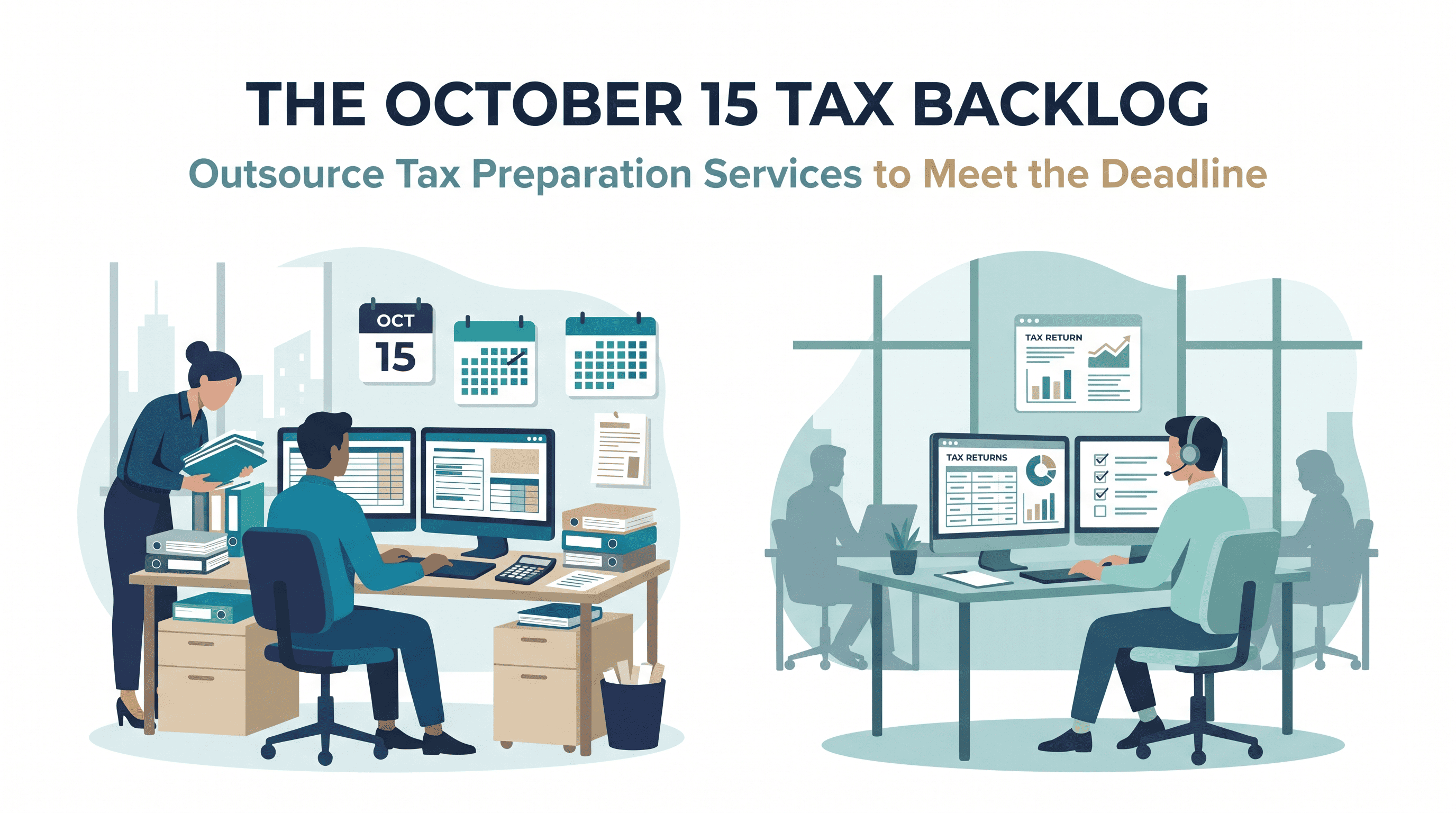
Every year, the same thing happens. The spring rush ends, the team catches its breath, and then summer slips away. Suddenly it is fall, a stack of extended returns is still sitting on the desk, and the October 15 deadline is days away. If that sounds familiar, you are not alone. Thousands of US firms hit this wall every year, and many of them now turn to outsource tax preparation services and extended return support as a proven way to finish on time without burning out their staff.
This post explains why the extension backlog builds up, what it costs when returns go out late, and how to use offshore staffing to clear the pile. It also covers what to do in the final days before the deadline and how to plan early enough next year so you never end up in the same spot. The advice works for small firms with a handful of preparers and for larger firms with dozens.
Why the October 15 Deadline Creates a Backlog
An extension does not make the work go away. It just moves the deadline. Individual taxpayers who file Form 4868 get until October 15 to file their 1040. Calendar year C corporations that file Form 7004 also land on October 15. The extension deadline works as a second busy season, but with less staff energy and less patience from clients.
A few things make this period so hard.
- Late documents. Clients who asked for an extension often did so because they were missing K-1s, brokerage statements, or other paperwork. Those documents tend to arrive in September and October, all at once.
- Complex returns. Simple returns are usually finished by April. What is left tends to be harder, with multiple states, partnership income, trusts, rental properties, and foreign reporting.
- Tired teams. After months of long hours, many staff have used their vacation days or left the firm. The people who remain are stretched thin.
- Competing work. Fall brings year end planning, new client onboarding, audit work, and payroll deadlines, all of which compete for the same hours.
The result is a tax return backlog that grows quietly during the summer and then becomes urgent in the first week of October.
Tax Season Burnout and CPA Burnout
Tax season burnout is one of the main reasons people leave public accounting. Even after April, the pressure does not fully lift, and the extension season brings it back. Managers work evenings and weekends to review returns, and preparers rush to finish piles of work without a break.
CPA burnout has real business effects.
- Mistakes go up when people are tired.
- Staff turnover rises, which leaves the firm short for next year.
- Partners spend more time fixing problems and less time with clients.
- Good people start looking for jobs at firms with better hours.
The staffing shortage in the profession makes this worse. When someone leaves, replacing them takes months, and the remaining team absorbs the work. A firm that depends on overtime to meet deadlines is only one resignation away from a crisis.
What Late Filing Penalties Can Cost You and Your Clients
Missing the October 15 deadline is not a small problem. Late filing penalties can add up quickly, and the extension only covers the time to file. It does not extend the time to pay. Taxes owed were due in April, so interest and failure to pay penalties may already be running.
Here is what to keep in mind.
- For individuals, the failure to file penalty is generally 5 percent of unpaid tax for each month or part of a month the return is late, up to a cap of 25 percent.
- Partnerships and S corporations face penalties that are charged per owner for each month the return is late.
- State agencies add their own penalties and interest on top of the federal amounts.
- Clients may blame the firm, even when the delay came from missing documents.
Beyond the money, late filings create stress, damage trust, and open the door for clients to look for another preparer. For many firms, one lost client costs more than the price of getting extra help.
What Is Extended Tax Return Outsourcing
Extended tax return outsourcing means sending part of your extension workload to a trained outside team, often located in India, that prepares returns while your own staff focuses on review, client contact, and filing. The team works inside your tax software, such as CCH Axcess or UltraTax, and follows your checklists and workpaper standards.
A typical setup looks like this.
- Your firm sends source documents and organizer data through a secure portal.
- The offshore team prepares the return in your software and completes the supporting schedules.
- A reviewer on the offshore side checks the work against your checklist.
- Your US preparer or manager does the final review, answers open questions, and signs off.
- Your firm handles client approval, e-file authorization, and filing.
You stay in control of the client relationship and the final result. The outside team supplies capacity. That is why it fits so well with seasonal CPA capacity needs.
How to Clear an Extension Backlog in 30 Days
If you have weeks and not days, a 30 day plan works well. If you only have a few days, skip to the next section.
Week 1 – Sort and prioritize
Pull a list of every open extended return. For each one, note the client name, return type, deadline, status, and what is missing. Then sort the list into groups.
- Ready to prepare, with all documents in hand
- Waiting on client documents
- In review
- Complex returns that need senior attention
Decide which returns your own team will handle and which will go out. Good candidates for outsourcing are returns that follow a set pattern, such as straightforward 1040s with wages, interest, dividends, and basic Schedule C or E activity, as well as 1120 returns and state returns that follow the federal numbers.
Week 2 – Send the first batch
Send a first batch of 10 to 20 returns to the offshore team along with the checklist, prior year files, and any special notes. Keep the batch small enough to review quickly so you can spot problems early. Ask for questions to be grouped in a single daily list so you can answer them in one block of time.
Week 3 – Scale up
Once your review shows the quality is on track, send larger batches. Move any returns that were waiting on documents into the queue as soon as the paperwork arrives. Keep a simple tracker, shared by both teams, that shows the stage of each return.
Week 4 – Review, finalize, and file
Use the last week for final review, client sign off, and e-file. Leave a buffer of at least two or three days before October 15 so that rejected e-files and last minute client calls do not push you past the deadline.
This plan lets your US team focus on high value tasks while the offshore team handles volume.
Split Team Shifts for Tax Preparation
One of the biggest advantages of offshore staffing is the time zone advantage. When it is end of day in New York, it is the next morning in India. This allows a split team shift model that keeps work moving around the clock.
Here is how a typical day may look.
- Late afternoon in the US. Your preparers finish for the day and upload the next batch of returns and open questions to the shared portal.
- Overnight in the US. The offshore team starts its workday, prepares the returns, and resolves any items covered by your checklist.
- Early morning in the US. Prepared returns and a list of open questions are waiting for your team when they log in.
- During the US workday. Your staff reviews the finished work, answers questions, talks with clients, and sends the next batch.
This cycle gives you close to 24 hours of progress each day. A return that would take three days with one team can often be finished in two. Over a 30 day window, that difference adds up to many more returns completed.
The key is clear handoffs. Use a standard template for questions, a shared tracker, and one point of contact on each side. A short call at the start of the US day helps keep everyone aligned.
How to Handle Extended Returns Before October 15
If you are reading this with the deadline just days away, the plan has to be tighter. Here is a practical checklist for how to handle extended returns before October 15.
- Count what is left. Make a complete list of open returns and mark each one as ready, waiting, or at risk.
- Chase missing documents today. Call or email clients with exact lists of what you need and a firm date, such as tomorrow at noon.
- Decide what to send out. Pick the returns that are ready to prepare but not yet started and get them to your offshore team immediately.
- Protect your review time. Block hours on the calendar for managers and reviewers. Review is the step most likely to be squeezed.
- Plan for e-file rejections. Submit early enough that you have time to fix errors. Do not wait until the last evening.
- Talk to clients who will miss the deadline. If a return cannot be completed because of missing information, explain the risk and the penalties, and ask for payment of any estimated tax owed to limit interest and penalties.
- Document your efforts. Keep notes on when you asked for documents and what clients replied. This protects the firm if a question comes up later.
In a short window, the goal is to get every possible return filed and to keep clear records on the ones that are not ready.
Offshore Staff for the October Deadline
Offshore staff for the October deadline can help in several ways.
- Fast ramp up. A good provider can often add trained preparers within days, not months.
- Familiar software. Many offshore preparers work daily in CCH Axcess, UltraTax, Lacerte, and ProConnect, so they need little time to learn your tools.
- Support for many return types. Teams can handle 1040s, 1120s, 1120-S, 1065, K-1 allocations, and state returns, along with the related workpapers.
- Flexible commitment. You can use the team for the busy weeks and scale down after the deadline, which keeps your cost in line with your workload.
- Relief for your staff. When your people see that help is on the way, morale improves, and overtime drops.
The point is not to replace your staff. It is to protect them from running on empty and to give your firm more room to serve clients well.
Review Process and Quality Control
Sending work out only makes sense if quality stays high. A strong review process has several layers.
- Preparer self check. The offshore preparer completes a checklist before submitting the return.
- Offshore reviewer. A second person on the provider's team checks math, tie outs, carryovers, and supporting schedules.
- US reviewer. Your preparer or manager does the final review and handles judgment calls.
- Final tie out. Before filing, someone confirms that the e-file data matches the signed return and that client authorization is in place.
Ask potential providers how they track error rates, how they handle review notes, and how they use feedback to improve. Track your own numbers during the first season, such as the number of review notes per return and the time spent on review. That data tells you when to send more work and when to adjust the process.
Protecting Client Data and Meeting Consent Rules
Tax returns hold some of the most sensitive data a client has. Before you use any outside team, make sure the basics are in place.
- Client consent. Under IRC Section 7216, a preparer who discloses return information to someone outside the US generally needs written consent from the client. Update your engagement letters and use the right consent language.
- Secure access. Look for secure remote desktops, multi-factor authentication, encryption, and restrictions on downloading or printing.
- Third party reports. Ask for a current SOC 2 report and a clear description of data handling policies.
- Confidentiality agreements. Every team member should sign them, and the provider should be able to show how access is removed when someone leaves.
- Written security plan. The FTC Safeguards Rule requires tax preparers to maintain an information security program, and your vendors are part of it.
Talk to your liability carrier and legal counsel if you have questions about your specific setup.
Plan Ahead for Seasonal CPA Capacity
The best way to survive the next October is to plan during the summer. A simple calendar helps.
- May and June. Review what went wrong this year and list the returns that were late or rushed.
- July. Choose a provider and run a small pilot on a few extended returns.
- August. Send a first wave of returns that are ready, and push clients for missing documents early.
- September. Scale up for the September 15 and September 30 extended filing dates for partnerships, S corporations, and trusts, and prepare for October.
- October. Focus on final review and filing, not on starting returns from scratch.
- November. Hold a short review meeting to decide what to change for next year.
Building seasonal CPA capacity into the plan turns the extension period from a crisis into a normal part of the year. It also makes it easier to hire full time staff for roles that truly need to be in the office, since the volume work has another home.
FAQs
1. What is extended tax return outsourcing?
It means outsourcing tax return preparation to an external team while your firm handles final review, client communication, and filing.
2. Can offshore teams help CPA firms meet the October 15 deadline?
Yes. Offshore teams can prepare returns and help firms manage backlogs before the deadline.
3. Which tax returns can be outsourced?
Firms can outsource 1040, 1120, 1120-S, 1065, K-1 allocations, and state tax returns.
4. How quickly can an offshore tax team start?
Depending on the provider, an offshore team may start within a week once software access and required client consent are arranged.
5. How does tax return outsourcing reduce CPA burnout?
It shifts routine preparation work to an external team, reducing overtime and giving in-house staff more time for review and client service.
