
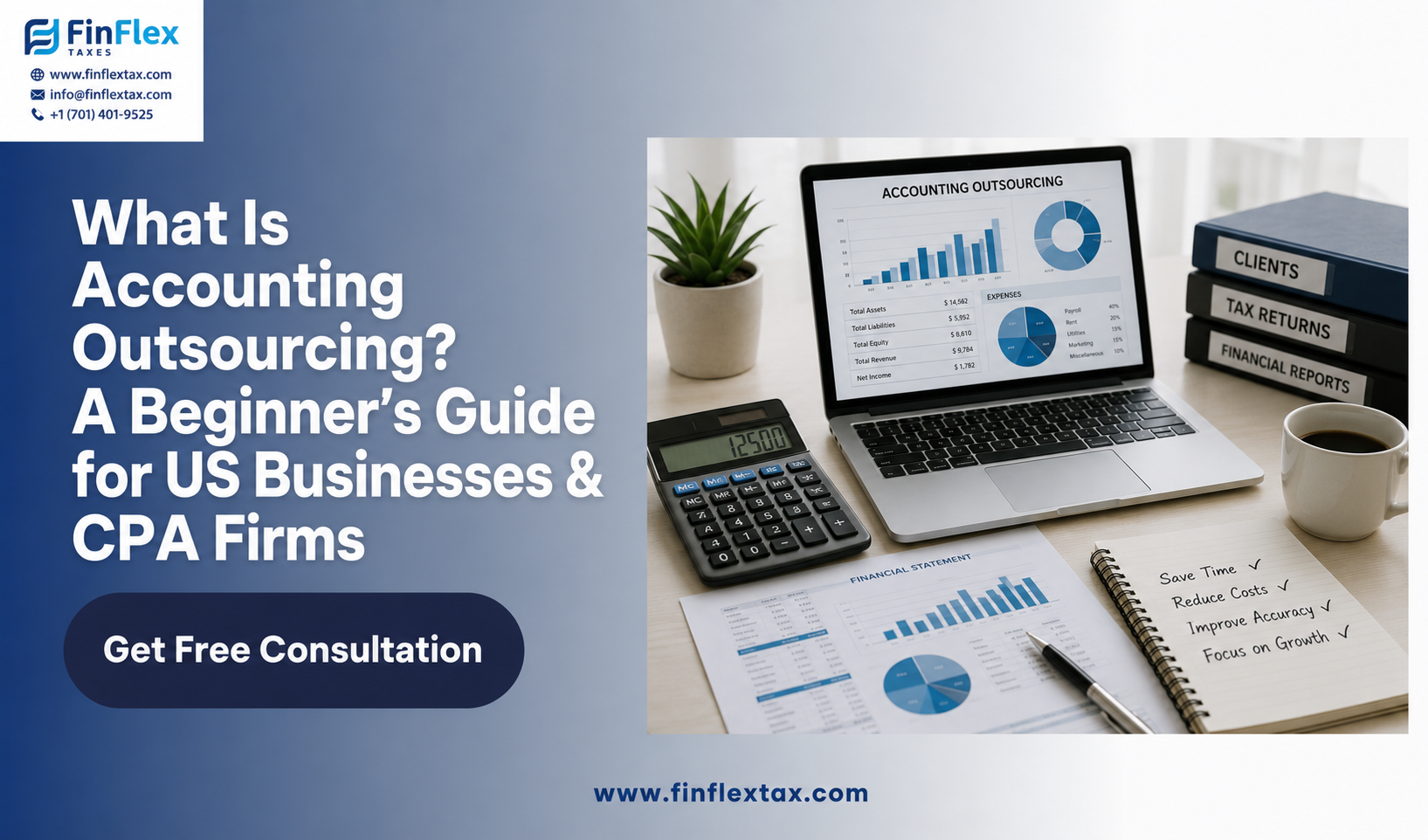
Quick Answer: Accounting outsourcing is the practice of hiring an external, often offshore, team of trained accountants to handle bookkeeping, financial reporting, tax preparation, payroll, or audit support on behalf of a business or CPA firm while the firm retains full oversight and final approval. For U.S. CPA firms, accounting outsourcing for CPA firms is most commonly used to reduce staffing costs, manage seasonal workload spikes, and access specialized tax and accounting expertise without hiring full-time local staff.
Key Takeaways
- Definition: Accounting outsourcing means delegating accounting tasks to an external provider instead of an in-house team.
- Primary users: U.S. CPA firms, small businesses, and growing companies without a full internal accounting department.
- Core services included: Bookkeeping, financial reporting, tax preparation, payroll, audit support, and accounts payable/receivable.
- Typical starting cost: Around $14/hour for offshore accounting support (FinFlex Taxes pricing).
- Best used: During tax season, periods of growth, or when reducing overhead is a priority.
- Key risk to manage: Data security mitigated through SOC 2, GDPR compliance, and NDAs.
What Is Accounting Outsourcing?
Accounting outsourcing is the process of hiring an external team typically based offshore to perform accounting functions on behalf of a business, instead of relying solely on in-house staff.
These functions can range from basic bookkeeping and data entry to full financial reporting, tax preparation, payroll processing, and audit support. The outsourced team works as an extension of the client's internal operations: they handle the transactional and preparation-heavy work, while the hiring business or CPA firm retains full oversight, reviews all output, and makes final decisions on filings, reports, and client deliverables.
For CPA firms specifically, accounting outsourcing usually means partnering with a provider based in a country like India, where a large pool of trained accountants and tax professionals is available at significantly lower hourly rates than equivalent U.S.-based staff. The firm's brand, client relationships, and final sign-off remain entirely in-house only the underlying labor is delegated.
In one sentence: Accounting outsourcing lets a firm get accounting work done by someone else's trained team, at a lower cost, while keeping full control over quality and client relationships.
Why Is Accounting Outsourcing Important for US CPA Firms?
Accounting outsourcing for CPA firms is important because it directly addresses three ongoing pressures: rising labor costs, a shrinking pool of qualified accounting talent, and workload spikes that don't match a fixed, year-round staffing model.
Here's how each pressure plays out in practice, and how outsourcing responds to it:
- Shortage of qualified accountants and CPAs in the U.S. job market : Outsourcing provides immediate access to trained accounting professionals without competing in a tight local hiring pool.
- Rising cost of salaries, benefits, and office overhead : Offshore accountants cost a fraction of local hires on a per-hour basis.
- Seasonal spikes during tax season and year-end close : Staffing can scale up or down without the cost of hiring and layoffs.
- Increasing client expectations for faster turnaround : Additional processing capacity shortens the time between intake and delivery.
- Industry shift toward advisory services : Outsourcing frees in-house CPAs from routine tasks to focus on higher-value client advisory work.
Because of these factors, accounting outsourcing has moved from being a seasonal convenience to a structural part of how many U.S. CPA firms plan their staffing and cost model each year.
What Services Are Included in Accounting Outsourcing?
Accounting outsourcing typically includes bookkeeping, financial reporting, tax preparation, payroll processing, audit support, and accounts payable/receivable management firms can choose a single service or bundle several together.
- Bookkeeping : daily transaction recording, bank/credit card reconciliations, chart of accounts management.
- Accounting & Financial Reporting : monthly/quarterly financial statements, general ledger management, accrual accounting.
- Tax Preparation : individual and business tax returns, including 1120, 1120-S, 1065, and K-1 allocations.
- Payroll Processing : payroll runs, multi-state payroll tax compliance, employee record management.
- Audit & Assurance Support — preparing supporting documentation and schedules for audit engagements.
- Accounts Payable & Receivable — invoice processing, vendor payments, collections tracking.
Most providers, including FinFlex Taxes, allow firms to start with one service — such as bookkeeping or tax preparation and expand into a full back-office arrangement over time as trust and workflow familiarity build.
How Does Accounting Outsourcing Work?
Accounting outsourcing typically follows six stages: consultation, onboarding, a trial period, team assignment, ongoing work with review, and periodic performance check-ins.
- Initial Consultation — The firm and provider discuss workload, required services, tools in use, and expected hours.
- Onboarding & Tools Setup — Access to accounting software (QuickBooks, Lacerte, Xero, etc.) and communication channels is configured.
- Trial Period — Most reputable providers offer a trial engagement, often under an NDA, so firms can evaluate quality before committing long-term. FinFlex Taxes structures this as a 15-day trial specifically for this reason.
- Team Assignment — Experienced accountants or tax professionals are matched to the firm's specific needs and industry.
- Ongoing Work & Review — The outsourced team handles day-to-day tasks; the hiring firm reviews, approves, and signs off on all final deliverables.
- Regular Performance Reviews — Periodic check-ins ensure the arrangement continues to meet expectations, with flexibility to adjust staffing as needs change.
This structured process is what separates a reliable outsourcing partnership from an unmanaged, high-risk arrangement firms should expect to see each of these stages clearly defined before signing on.
FinFlex Taxes Pricing for Accounting Outsourcing
FinFlex Taxes offers accounting outsourcing services starting at $14/hour, with pricing structured around three models: hourly billing, a dedicated monthly staff arrangement, or a discounted 15-day trial rate.
- Hourly Rate (from $14/hour) — best for firms with variable or unpredictable workloads; you pay only for actual hours worked.
- Dedicated Staff Model — best for firms wanting consistent, long-term offshore support; a fixed monthly cost secures a dedicated accountant working exclusively with the firm.
- 15-Day Trial Rate — best for firms testing the relationship before committing; a discounted rate applies during an initial 15-day trial period under NDA.
Final pricing depends on the scope of services requested, the complexity of the firm's chart of accounts, and reporting cadence, but the starting rate makes FinFlex significantly more cost-effective than most local hiring alternatives for U.S. CPA firms.
Benefits of Accounting Outsourcing
The core benefits of accounting outsourcing are lower operational costs, access to experienced professionals, scalability, faster turnaround, reduced overhead, and stronger data security when working with a compliant provider.
- Lower Operational Costs — offshore accountants cost a fraction of local hires once salary, benefits, and overhead are factored in.
- Access to Experienced Professionals — providers supply accountants trained in U.S. GAAP, IRS compliance, and multi-state requirements.
- Scalability — support can increase or decrease based on seasonal demand or firm growth, without hiring/layoff costs.
- Faster Turnaround — more hands working on reconciliations, reporting, and filings speeds up completion, especially in peak periods.
- Reduced Overhead — no added office space, equipment, or software licensing costs for outsourced staff.
- Improved Focus on Core Work — in-house CPAs spend more time on advisory services and client relationships.
- Software Integration — experienced providers work directly within QuickBooks, Lacerte, Xero, and similar platforms.
- Data Security — reputable providers follow SOC 2, GDPR, and encrypted access protocols to protect client information.
When Should a Company Use Accounting Outsourcing Services?
A company should consider accounting outsourcing when it faces a workload spike, staffing shortage, overhead pressure, or lacks an in-house accounting function entirely. Specific triggers include:
- During tax season, when workload spikes far beyond normal in-house capacity
- When a firm is growing quickly and needs more accounting support without the delay of hiring
- When local hiring is difficult or expensive, particularly for specialized roles
- When a firm wants to reduce overhead without sacrificing service quality
- When a business has no in-house accounting department and needs reliable, affordable support
- When a firm wants to test a new staffing model with a low-risk trial engagement before committing long-term
If two or more of these apply to your firm right now, it's a strong signal that accounting outsourcing is worth formally evaluating.
Conclusion
Accounting outsourcing has moved from a niche cost-cutting tactic to a mainstream, structural strategy for U.S. businesses and CPA firms looking to stay competitive, reduce overhead, and access skilled talent without the constraints of local hiring. Whether it's bookkeeping, tax preparation, payroll, or full back-office support, outsourcing gives firms the flexibility to scale exactly when they need it without the long-term cost of building an entire in-house team from scratch.
For firms considering this path, the safest way to evaluate fit is to start with a 15-day trial engagement and choose a provider with clear compliance credentials, transparent pricing, and proven experience with U.S. accounting and tax requirements.
Ready to explore accounting outsourcing for your firm? Book a free consultation with FinFlex Taxes to get started.
Frequently Asked Questions
1. What is accounting outsourcing?
Accounting outsourcing is when a business or CPA firm hires an external team, typically offshore, to handle bookkeeping, reporting, payroll, and tax preparation instead of managing everything in-house while retaining full oversight and final approval on all deliverables.
2. What are the main benefits of accounting outsourcing?
The benefits of accounting outsourcing include lower operational costs, faster turnaround during peak periods, access to accountants already trained in U.S. GAAP and tax compliance, and the ability to scale support up or down without hiring or layoff costs.
3. Is accounting outsourcing for CPA firms only useful for large practices?
No. Small and mid-sized CPA firms often benefit the most from accounting outsourcing, since it gives them access to experienced accounting support without the cost of hiring full-time in-house staff.
4. How much does accounting outsourcing cost?
Accounting outsourcing typically starts around $14–$25/hour with FinFlex Taxes, depending on the provider and scope of work, with options for hourly billing, per-task pricing, or a dedicated monthly staff model.
5. How do I find reliable accounting outsourcing companies in India?
Look for accounting outsourcing companies in India that can show SOC 2 or GDPR compliance, signed NDAs, direct experience with U.S. GAAP and IRS rules, and a trial period that lets you verify quality before committing long-term.
6. Can outsourced accountants work with the software my firm already uses?
Yes. Most established providers are experienced with common platforms like QuickBooks, Xero, Lacerte, and CCH Axcess, allowing them to integrate directly into a firm's existing workflow without disruption.
